


Power Plant and Industrial Cooling Solutions (PCS)
Products and Services

Power Plant and Industrial Cooling Solutions (PCS) Power Plant and Industrial Cooling Solutions (PCS)
Our Services
In many industries, it is essential to dissipate the heat generated during the production process to maintain temperatures at required levels. Consequently, cooling systems are a critical component in ensuring the quality of industrial outputs.
MAPNA MD-1 possesses extensive and long-standing experience in the design, procurement, and execution of power plant cooling systems. We have the capability to implement a wide range of cooling systems, including Once-Through, Air-Cooled (ACC and Heller), and the conversion and execution of Hybrid Cooling Systems. The solutions provided by MAPNA MD-1 for converting wet cooling systems to dry or hybrid systems allow for significant reductions in water consumption and a substantial increase in efficiency in this sector.
Applications ::
- Power Plants and Large Industries: Power plants and heavy industries that generate heat require robust cooling systems and are the primary clients for MAPNA MD-1’s solutions.
- Water Challenge: Given the current water scarcity crisis in Iran, power plants currently utilizing wet cooling systems are specifically targeted for our conversion solutions (retrofitting to dry or hybrid systems).
1. Main Cooling Systems
1-1. Once-Through Cooling Systems
In this system, water from a natural source (such as a river or sea) enters a surface condenser. After exchanging heat with the steam exiting the turbine, the water becomes heated and is returned to its original source. While this system offers the highest thermodynamic efficiency due to the low temperature of the cold watersource, environmental impact must be carefully studied during design—specifically water temperature increase, intake/discharge location, and the impact on local ecosystems, as heated water reduces oxygen levels and can harm aquatic life.

2-1. Air-Cooled Condenser (ACC) Systems
In this system, steam exiting the low-pressure turbine is transferred directly through steam ducts and a steam distribution system into tube bundles. These tubes feature external fins and are exposed to airflow from fans, causing the steam to condense. Essentially, there is no separate condenser; these tube bundles act as the condenser. The cooling air passes over the bundles, absorbing the latent heat of the steam, causing a phase change inside the tubes. The steam flows downward through the bundles (arranged in an A-frame structure), condensing along the path. The condensate is collected and transferred to the storage tank. Non-condensable gases are removed via an air extraction system. The collected condensate is then pumped back to the feed system. Airflow is maintained by horizontally mounted axial fans. Fan control is typically managed via two-speed fan motors or Variable Frequency Drives (VFDs). The advantages of this system include high reliability under all weather conditions and fast, secure installation, though its efficiency is lower than once-through or wet tower systems.

3-1. Heller Systems (Indirect Air Cooling)
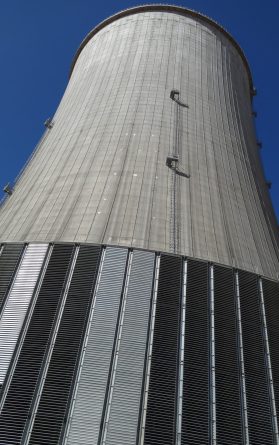
In this system, steam exiting the LP turbine is first condensed in a spray-condenser through direct contact with water. The cooling water, having absorbed the heat from the turbine exhaust, is then pumped to the Heller tower. The hot water is cooled through natural draft airflow across heat exchangers, known as “Deltas,” which are arranged vertically in a triangular formation around the perimeter of the tower. The natural draft, created by pressure and temperature differentials, cools the water, which then returns to the condenser to absorb more heat.
4-1. Hybrid Cooling Systems
The issue of water resource depletion in Iran’s arid and semi-arid climate has significantly impacted the choice of cooling systems.
Dry/Air-Cooled systems are the most suitable from the perspective of minimizing water dependency. However, process requirements (such as the maximum allowable inlet temperature) sometimes limit the use of these systems alone across all ambient temperatures.
Wet cooling systems offer the best cooling efficiency and enable suitable process conditions in all climates, but their high water consumption year-round is unsuitable for water-scarce regions.
Hybrid cooling systems leverage the strengths of both, minimizing water dependency while maintaining appropriate fluid temperatures for consumers. These systems can be designed with a specific “design point” for the dry section, allowing it to dissipate heat without water consumption up to that temperature. As ambient temperatures drop below the design point, the dry section becomes more efficient, even providing temperatures lower than required.
Conversely, when ambient temperature exceeds the design point, the output water temperature rises, and the “wet section” is activated to achieve the target temperature by dissipating the remaining heat through evaporation. Naturally, as the ambient temperature rises further, the wet section’s share of heat dissipation—and thus water consumption—increases.

This product includes five sub-categories:
- Closed Hybrid Cooling System
- Open Hybrid Cooling System
- ACC + Wet Tower Hybrid Cooling System
- Forced Draft Heller Tower + Wet Tower Hybrid Cooling System
2. Auxiliary Cooling Systems Cooling Systems
Auxiliary cooling systems utilize a circulating water fluid to cool the auxiliary components of the main plant equipment, including turbine oil coolers, generator air coolers, cycle feed pumps, sampling coolers, and compressors. In most cases, air-cooled heat exchangers are used.
1-1. Auxiliary Cooling with Forgo-type Exchangers
This system uses Forgo air-cooled exchangers (aluminum tubes and fins). Airflow is provided by fans mounted above the tube bundles in a V-shaped structure. The circulating cooling water is demineralized water. In cold seasons, to prevent freezing, the water is drained into storage tanks. In hot seasons, water is sprayed onto the exchangers (Deluge mode) to achieve the required cooling temperature.

2-1. Auxiliary Cooling with Flat Fin-Fan Exchangers
This system uses flat air-cooled exchangers (carbon steel tubes and aluminum fins). Airflow is provided by fans located below the horizontally mounted tube bundles. The circulating cooling water is a mixture of demineralized water and antifreeze, eliminating the freezing risk in cold seasons without the need to drain the system. This system is suitable for temperate and cold climates and does not use deluge spray, resulting in water savings for the power plant.

3. Capabilities and Advantages of MAPNA MD -1 MAPNA MD -1
- Conducting studies and feasibility assessments to increase efficiency in cooling systems.
- Design and engineering using native MAPACC tools.
- Procurement, installation, and commissioning of various cooling systems as EPC projects.
- Retrofitting/Conversion of wet systems to dry and hybrid systems to significantly reduce water consumption.
Our Projects

